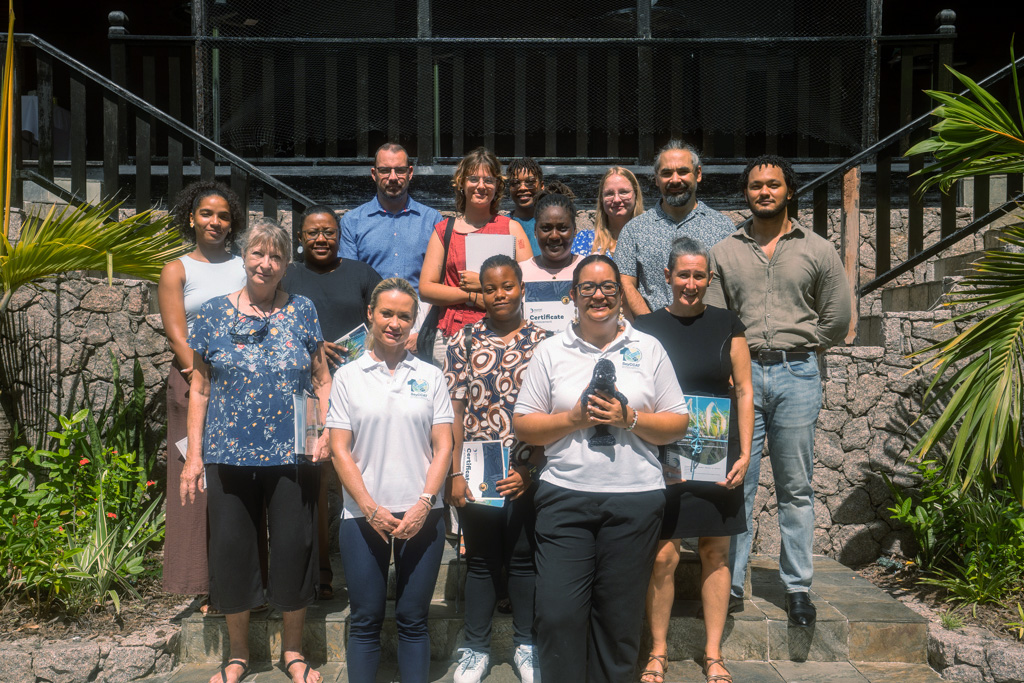
The Seychelles Conservation and Climate Adaptation Trust (SeyCCAT) held a ceremony on April 30th, 2026, to officially hand over the Seychelles’ Seagrass Assessment, Monitoring and Restoration Protocols, the new Seagrass Identification Flipcharts, and to recognise the participants who successfully completed the associated training programme.
Seagrass ecosystems are among Seychelles’ most valuable natural assets, protecting coastlines, supporting fisheries, and storing significant amounts of carbon. The 1,599.2 sq km of seagrass mapped across the Seychelles Exclusive Economic Zone accounts for 96% of the national blue carbon stock.
As highly valued nature-based solutions (NbS) for climate change, these meadows are estimated to store 18.9 million tonnes of organic carbon, equivalent to approximately 69 million tonnes of CO₂. Their annual sequestration rate of around 510,000 tCO₂e is roughly equal to the annual emissions from Seychelles’ entire energy sector.
The development of monitoring protocols gives Seychelles a consistent and reliable way to track the health of its seagrass meadows. This was emphasised by the Chief Executive Officer of SeyCCAT, Ms Helena Sims, who stated the following in her speech, “The development of these monitoring protocols is a major milestone. They provide Seychelles with a standardised, scientifically robust framework for collecting data that is consistent, credible, and nationally aligned. This is essential for strengthening our NDC reporting, supporting the Marine Spatial Plan, and guiding long-term ecosystem management and policy decisions.”
A key addition to the protocol is the Seagrass Identification Flipchart, a practical field resource created by Dr Jeanne A Mortimer, that supports accurate species identification and consistent data collection across monitoring sites. The flipchart bridges the gap between technical guidance and real-world application, making the protocols more accessible for field teams nationwide.
The protocol itself was developed by Bee Ecological Consulting, a local consulting firm, which then applied the toolkit during training sessions with 18 participants from diverse governmental and non-governmental organisations. Participants included Corinne Julie and Esthel Didon from Nature Seychelles, Emma Mederic, Diary Rakontondrazara, Elizabeth Wareing, James Wareing and Said Harryba from Island Conservation Society, Gabriella Carrara, and Swamee Tamboo from Seychelles Parks and Gardens Authority, Mirella Louise, from Seychelles Islands Foundation.
The handover ceremony was attended by representatives from partner ministries, agencies, and NGOs, as well as technical experts, reflecting the collaborative effort that underpins Seychelles’ leadership in marine conservation and its commitment to evidence-based coastal wetland stewardship.